
The Hunt for Ghost Particles
In an abandoned gold mine, scientists are looking for particles that are so elusive that they need to build detectors the size of Olympic swimming pools to capture them. If the experiments on these particles go as planned, they could answer the biggest question in the universe, “why are we all here?”. These so-called ghost particles are time-traveling neutrinos. Well, what are neutrinos? They are tiny particles in the electron family that are very light and don’t interact much, so they pass through us; they are so abundant that about 100 trillion neutrinos are passing through you in this instant. Scientists consider these particles to be fundamental building blocks of matter, which are a part of the (Standard model of elementary particles), which is like the periodic table of particle physics.
When the big bang occurred, it released a considerable amount of energy, and as this energy cooled, it formed particles. In the moments after the big bang, matter won over antimatter due to some strange and unknown force, and this caused an imbalance between matter and antimatter that left us with a tiny bit of matter that we see today. Scientists believe neutrinos were the cause behind this imbalance. Physicists study neutrinos because they have very odd characteristics. The particles seem to break laws that describe the fundamentals of nature: they are also thought to be messengers from the unknown outer regions of the universe, which might tell things that ordinary particles can’t. Scientists have theorized about the existence of neutrinos since the 1930s, but they did not have the technology to find them until now. Neutrinos are primarily present in the cosmic rays that hit the earth from the sun; they can not only travel to matter with ease, but they also come in what scientists call flavors.
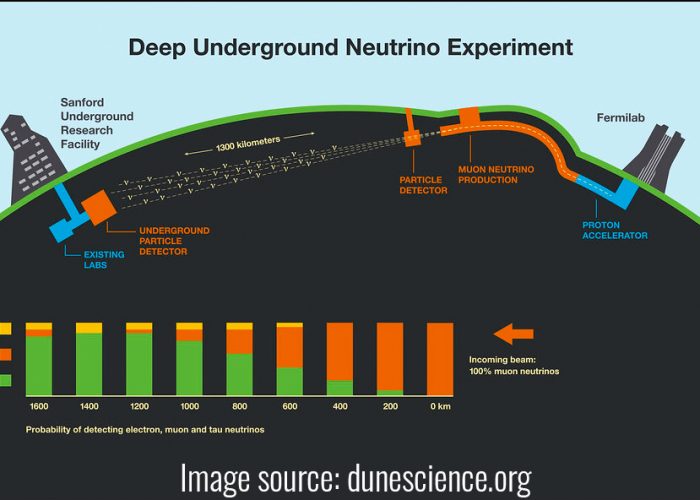
Neutrinos come in 3 different flavors, known as electron neutrino, muon neutrino, and tau neutrino, and are known to oscillate; this is very interesting to physicists because if the neutrinos oscillate, it means that it contains mass; this can help us understand why the universe has mass. To help detect these oscillations, physicists are building the world’s largest detector known as DUNE (Deep underground neutrino explement). It is the world’s largest detector because it uses a massive particle beam that stretches from Fermilab in Chicago to the Stanford underground research facility in South Dakota, which shoots neutrinos and anti-neutrinos on an 800-mile journey through an underground tunnel where it is finally detected in South Dakota. DUNE will detect how a neutrino oscillates and or changes flavor when it interacts with atoms. Due to DUNE’s enormous size and scale, it is said to be completed by 2027. Scientists hope it will allow us to understand better how the universe works.